

HiltonC
A standard wet-pipe sprinkler system is a workhorse. It protects warehouses, offices, and light industrial occupancies with decades of reliable performance behind it. But put that same system in front of a flash fire hazard — a pressurized hydrocarbon process line, a transformer bay filled with dielectric oil, a compressor skid operating at elevated temperature — and its fundamental design premise becomes a liability. Water in the pipe, waiting.
Deluge and pre-action systems were engineered specifically for environments where a slow, localized response is not good enough. They apply water — or hold water back — based on system logic that standard sprinklers simply don’t have. Getting that logic right is the difference between suppression and escalation.
What Makes Deluge and Pre-Action Systems Different
Both deluge and pre-action systems use a control valve — driven by a detection signal rather than heat-actuated sprinkler heads alone — to govern when water enters the distribution piping. That shared characteristic separates them from wet-pipe and dry-pipe systems in both performance and engineering complexity.
In a deluge system, all sprinkler or spray nozzles are open at all times. The piping is dry. When a fire or heat detection signal triggers the deluge valve, water floods the entire protected zone simultaneously. There is no sequential activation by individual heads. The system drenches everything in the protected area at once — and that is precisely the point. For hydrocarbon pool fires, flammable liquid spills, or aircraft hangar hazards, a fast, simultaneous application over the entire hazard footprint is what suppression requires. Partial wetting is not an option when the fuel is everywhere.
A pre-action system uses closed sprinkler heads — like a wet-pipe system — but keeps the piping dry or pressurized with air or nitrogen until a supervisory detection event releases the pre-action valve and floods the distribution piping with water. The sprinkler heads then operate individually by heat, as in a standard system. Pre-action systems are used where accidental discharge would cause severe secondary damage — data centers, museums, cold storage, switchgear rooms, and electrical infrastructure where water damage to equipment would be catastrophic even before a fire is fully developed.
The key engineering distinction: deluge systems maximize suppression speed and coverage. Pre-action systems maximize discharge selectivity and false-alarm protection.
Where Each System Belongs: Hazard-Driven Selection
NFPA 13 and NFPA 15 provide the prescriptive and performance criteria for these systems, but correct system selection begins with hazard analysis — not with a spec sheet. The hazard type, fire growth rate, fuel characteristics, and consequence severity all drive the decision.
Deluge systems are appropriate where:
- The hazard involves flammable liquids or gases that can produce a rapid, spreading fire across the entire protected area before localized suppression could engage.
- The material is pressurized and a release event could produce a flash fire or BLEVE (boiling liquid expanding vapor explosion) scenario.
- Cooling of adjacent equipment — pressure vessels, structural steel, critical infrastructure — must begin immediately and uniformly to prevent escalation.
- NFPA 15 fixed water spray applications call for simultaneous system operation over the protected surface, such as vessel cooling rings or transformer deluge systems.
Pre-action systems are appropriate where:
- The occupancy contains high-value or water-sensitive equipment that must be protected from inadvertent discharge.
- A double-interlock configuration (requiring both a detector signal and sprinkler head activation to open the valve) provides the highest available protection against false discharge.
- Electrical or electronic infrastructure demands that system activation be confirmed before water enters the pipe.
In Saudi industrial facilities, this selection logic must be reconciled with SAES requirements and Saudi Aramco engineering standards, which define protected area classifications and system type mandates for specific facility types. Where SAES standards impose more stringent requirements than NFPA, the SAES requirement governs. Engineers who apply NFPA criteria without checking the applicable SAES standard create compliance gaps that surface at the worst possible time — during Saudi Civil Defense inspection or incident investigation.
Engineering the Deluge Valve: The System’s Critical Node
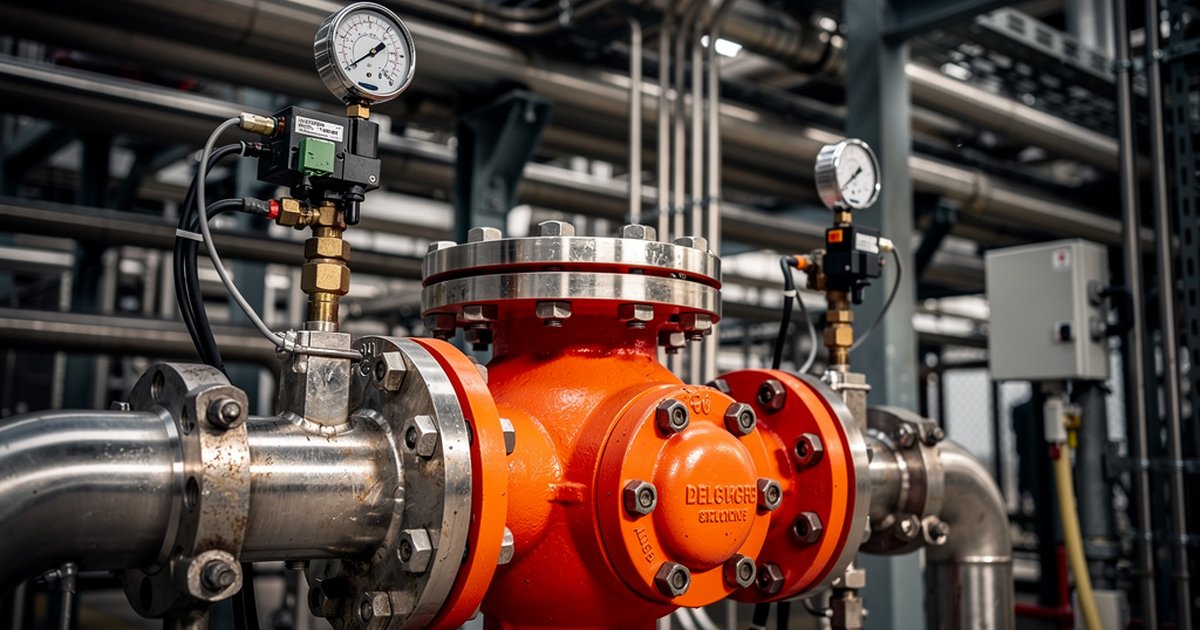
The deluge valve is the single most critical component in these systems. It must open reliably on demand and remain closed against false signals. Failures in either direction are consequential: a valve that fails to open leaves the hazard unprotected; a valve that opens inadvertently floods an operational area with no fire present.
Deluge valves are hydraulically, pneumatically, or electrically actuated, and the actuation logic is typically driven by a dedicated fire detection circuit — flame detectors, heat detectors, linear heat detection cable, or open-area smoke imaging — depending on the hazard and environment. The detection system design is inseparable from the suppression system design. An engineer who specifies a deluge system without engineering the detection logic to match has delivered an incomplete solution.
Key engineering parameters for the deluge valve and actuation train include:
- Actuation pressure and flow requirements: The valve must operate within the available system pressure range at its trigger point. Hydraulic calculations must account for friction losses from the supply to the valve and from the valve to the most remote nozzle.
- Supervision of the detection circuit: Detection circuits must be supervised for opens, shorts, and ground faults. A loss of supervision on the detection circuit must generate a trouble signal, not a discharge signal.
- Manual release provisions: NFPA 13 and NFPA 15 require local manual release capability. Placement and accessibility of manual stations must be part of the engineering layout — not an afterthought.
- Trim piping and draining: The valve trim — the assembly of small-bore piping, solenoids, and test connections that control the valve — must be engineered for the environment. Outdoor installations in high-temperature environments require heat-traced or insulated trim to prevent degradation of elastomeric components.
Hydraulic Design: Getting the Numbers Right
The hydraulic design of a deluge or pre-action system is more demanding than a wet-pipe system because the entire protected area demands simultaneous water delivery — not just the most demanding group of heads. Every nozzle in the system must be sized and positioned to deliver the required density across the hazard footprint, and the hydraulic calculations must confirm that available supply pressure and flow support full simultaneous operation.
For NFPA 15 water spray systems protecting equipment such as pressure vessels or process piping, the design must meet minimum application rates for the specific hazard type — cooling, exposure protection, or fire control — applied over the entire protected surface area. These are not interchangeable; the rate required to prevent vessel failure from heat exposure is not the same rate required to extinguish a pool fire on the ground below.
In facilities operating under SAES engineering standards, the design basis for hydraulic calculations — including supply pressure, storage volume, and pump redundancy — must align with the SAES fire water supply requirements applicable to the facility tier. This ties the deluge system design directly to the site-wide fire water engineering: ring mains, storage tanks, and pump configurations must be able to support simultaneous operation of the largest credible demand scenario, which in a process facility may include multiple deluge systems activating concurrently.
Pre-Action System Configurations: Single- vs. Double-Interlock
Pre-action systems come in two primary configurations, and selecting the wrong one is a common engineering error that creates either excessive risk of false discharge or delayed suppression response.
A single-interlock pre-action system requires only a detector signal to open the pre-action valve and flood the distribution piping with water. The individual sprinkler heads still open by heat, providing a second layer of confirmation before discharge. This configuration is appropriate where water damage from premature flooding of the piping — but before a sprinkler head opens — is the primary concern.
A double-interlock pre-action system requires both a detector signal and an individual sprinkler head operation before water is released. This provides the highest protection against inadvertent discharge. However, it also introduces the longest response time of any automatic sprinkler configuration, because two independent events must occur in sequence. Double-interlock systems are only appropriate where the protected contents can tolerate that delay — and where a dedicated fast-response detection system is in place to initiate the first interlock before a fire grows beyond the suppression capacity of the system.
The engineering decision between single- and double-interlock must be documented in the design basis, with explicit acknowledgment of the response time implications. Facilities that specify double-interlock systems for electrical rooms and then discover the detection system was designed for ambient conditions — rather than the fast-response criteria the double-interlock logic requires — have created a system that looks compliant on paper but will underperform in a real event.
Testing, Commissioning, and Long-Term Reliability
Deluge and pre-action systems require more rigorous commissioning and ongoing maintenance than wet-pipe systems — and that reality is frequently underestimated at the project planning stage. The detection circuit, actuation logic, valve trim, and hydraulic distribution piping must all be tested as an integrated system, not as individual components signed off sequentially.
NFPA 25 inspection, testing, and maintenance requirements for deluge and pre-action systems include periodic full-flow trip tests of the deluge valve — a test that requires coordination with operations, since it results in water discharge in the protected area. Facilities that defer or skip these tests accumulate unknown system degradation. Solenoid actuators corrode. Trim piping develops scale. Elastomeric seats in the valve body harden. None of these failure modes are visible without testing — and all of them result in a system that appears operational but will not perform.
In Saudi industrial facilities, SAES maintenance requirements must be incorporated into the inspection program alongside NFPA 25. Where the two frameworks impose different frequencies or testing methods, the more stringent requirement governs — and that determination should be made by a qualified fire protection engineer, not by the maintenance scheduler.
The Bottom Line
Deluge and pre-action systems are not upgrades to standard sprinkler systems. They are purpose-engineered solutions for hazard scenarios that standard systems cannot address. Getting the selection right requires hazard analysis, not assumption. Getting the design right requires hydraulic rigor, integrated detection logic, and compliance with both NFPA and applicable SAES standards. And getting the long-term performance right requires a commissioning and maintenance program that treats the system as what it actually is: critical life-safety infrastructure in an environment where a failure has consequences that extend far beyond the protected area.
Specify it correctly. Design it completely. Test it as a system. That is the only standard that matters when the hazard is real.
Work With Ignis Sentinel Engineering
Need a fire risk assessment, a third-party plan review, or an NFPA/SAES
compliance check for your facility? Our engineers help Saudi and international
industrial operators design safer operations.