


HiltonC
Selecting the wrong suppression agent for a flammable-liquid hazard does not simply mean a slower knockdown. It can mean re-ignition, foam blanket breakdown, uncontrolled boilover, or a total loss event that never needed to happen. For engineers and HSE managers specifying fire protection systems on Saudi and international petrochemical facilities, the choice between foam, water, and hybrid approaches is one of the highest-consequence engineering decisions on the project.
The good news: the decision framework is knowable. NFPA 11, NFPA 30, and Saudi Aramco Engineering Standards (SAES) lay out clear criteria. The challenge is that each data set — fuel type, tank geometry, storage temperature, vapor pressure, available water supply — shifts the answer. This article walks through the technical logic so facility engineers can enter the selection process with a defensible position rather than a vendor preference.
Why Agent Selection Is Not a Commodity Decision
Water remains the world’s most common fire suppression agent for a reason: it is abundant, inexpensive, and effective at absorbing heat. But water applied incorrectly to a flammable-liquid surface can cause steam explosions, slopover, or the physical displacement of burning product over the rim of a tank. In polar solvents — alcohols, esters, ketones — standard protein and fluoroprotein foams simply break down on contact. The wrong foam applied to ethanol is, in practical terms, no foam at all.
Foam systems introduce their own variables. Expansion ratio, application rate, drain time, and compatibility with the base fuel all determine whether a foam blanket will seal and hold. NFPA 11 (Standard for Low-, Medium-, and High-Expansion Foam) provides the foundational application rates and design parameters. Those rates are not conservative suggestions — they are the engineering minimums derived from full-scale fire testing. Applying a lower rate to save capital cost is a compliance gap and a liability waiting to manifest.
Hybrid systems — typically a combination of foam concentrate injection with water-spray cooling or fixed monitor supplementation — add operational complexity but fill performance gaps that neither agent covers alone. They are increasingly common on large-diameter floating-roof tanks and on facilities where the consequence of a rim-seal fire escalating to a full-surface fire is catastrophic.
NFPA 11 and NFPA 30: The Technical Baseline
NFPA 11 governs foam system design — concentrate type, expansion ratio, application density, and equipment selection. Key distinctions the standard draws:
- Low-expansion foam (up to 20:1): The workhorse for flammable-liquid tank protection. Protein, fluoroprotein, film-forming fluoroprotein (FFFP), and aqueous film-forming foam (AFFF) all fall here. Each has a different drainage time, fuel compatibility profile, and preferred application method.
- Alcohol-resistant AFFF (AR-AFFF): Required whenever polar solvents are involved. The polymeric structure in AR-AFFF forms a separate membrane on the fuel surface rather than relying solely on the aqueous film. Without it, the foam blanket is consumed by the polar solvent and suppression fails.
- Application method matters as much as concentrate type: Sub-surface injection, semi-sub-surface injection, top-pouring via fixed chambers, and mobile monitor application each produce different foam quality on arrival at the fuel surface. Sub-surface injection, for example, is acceptable only on non-water-miscible hydrocarbons — it cannot be used on polar solvents because the foam degrades before reaching the surface.
NFPA 30 (Flammable and Combustible Liquids Code) governs storage facility design and sets the foundation that foam system designers must satisfy — tank spacing, impoundment sizing, drainage slope, and the spill containment geometry that determines how a ground-level spill fire will behave. A foam system that meets NFPA 11 application rates but is installed on a facility where the impoundment berm directs burning product toward a process unit is still an inadequate fire protection solution.
SAES Overlay: Where Saudi Aramco’s Requirements Tighten the Specification
Saudi Aramco’s Engineering Standards add a layer of specificity on top of NFPA that operators in the Kingdom must satisfy concurrently. Several SAES documents govern fire and gas system design, foam system specification, and the fire water network that feeds suppression systems. The key engineering implications:
- Application rates are often more demanding than NFPA minimums. Saudi Aramco’s operating experience in high-ambient-temperature environments — where foam drain time accelerates and vapor production from heated product increases — informs application rates that exceed the NFPA 11 base case. Engineers specifying systems to NFPA minimums alone and claiming SAES compliance need to verify that claim carefully.
- Fixed vs. semi-fixed vs. mobile equipment hierarchy. SAES standards establish when fixed foam systems are mandatory versus when supplemental mobile equipment is acceptable. For large atmospheric storage tanks above certain diameter thresholds, fixed rim-seal protection and supplemental fixed chamber systems are typically required — mobile equipment is supplemental, not primary.
- Firewater supply reliability. Foam systems are only as good as the firewater network feeding the proportioner. SAES requirements for firewater loop design, pumping redundancy, and minimum flow duration at design demand are more prescriptive than the NFPA baseline. A foam system design that ignores the firewater hydraulics upstream is an incomplete design.
- Documentation and third-party review. Saudi Aramco’s project delivery process typically requires engineering calculations and system designs to go through a defined review gate. Third-party fire protection engineering review is standard practice on major projects — not an optional quality assurance step.
The Floating-Roof Tank Problem
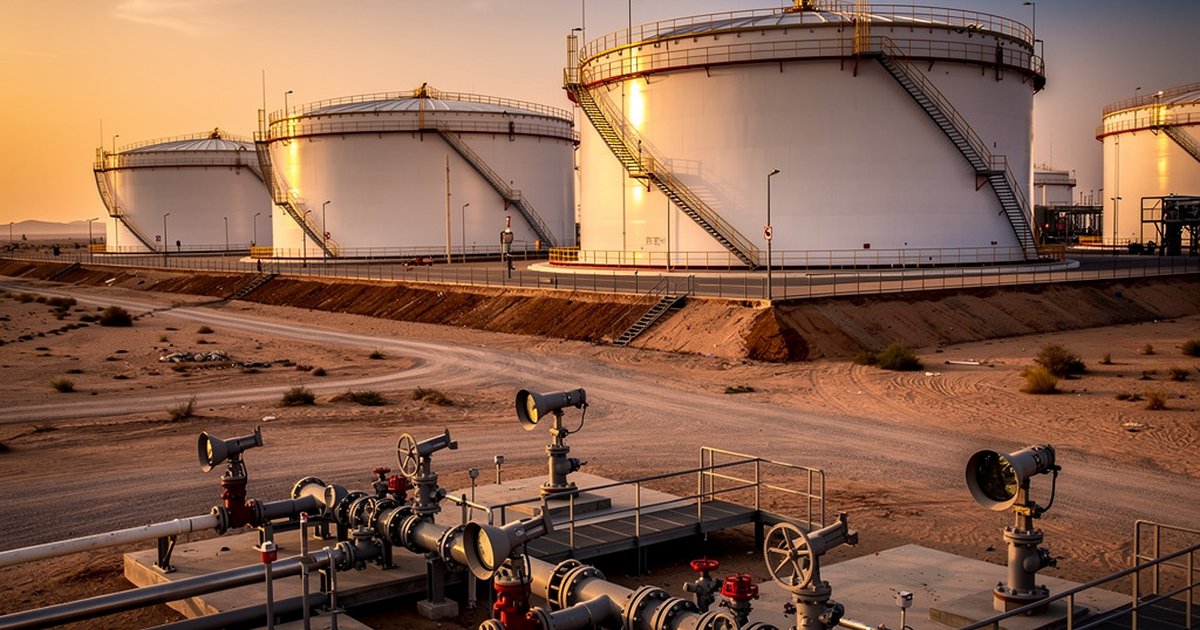
Floating-roof tanks represent the most common large-volume storage configuration for crude oil and light hydrocarbons in the Gulf region. They also present the most technically nuanced suppression challenge. The rim seal — the gap between the floating roof and the tank shell — is the ignition-vulnerable zone. Rim-seal fires, if not controlled quickly, can destabilize the roof and escalate to a full-surface fire, which is a categorically different suppression challenge requiring dramatically higher application rates and resources.
The engineering response to this geometry is layered:
- Fixed foam chambers: Mounted on the tank shell at roof level, discharging foam onto the annular seal area. Discharge outlets must be positioned to ensure full circumferential coverage — gaps in coverage translate directly to gaps in suppression.
- Foam dams: Sheet-metal barriers on the roof surface that retain the applied foam in the annular zone rather than allowing it to drain toward the center of the roof. The dam height and configuration are defined in NFPA 11 and must be maintained as part of the NFPA 25 inspection program.
- Water cooling on the tank shell: Shell cooling via fixed monitors or deluge rings reduces the heat flux the foam blanket must work against, extending effective suppression time. This is the hybrid element — foam suppresses, water cools.
For tanks above a certain diameter — the threshold varies by standard edition and the AHJ’s interpretation — the required foam application rate and total foam concentrate inventory become significant infrastructure commitments. Engineers who size the foam concentrate tank to the minimum rate and then discover that the facility’s risk profile or the AHJ’s interpretation demands a higher rate face expensive retrofits.
When Water-Only or Water-Mist Systems Are Appropriate
Not every flammable-liquid hazard requires foam. Water-based suppression remains the correct choice in several contexts:
- Cooling exposure protection: Where the goal is protecting adjacent structures or equipment from radiant heat rather than directly suppressing a pool fire, water spray and monitor systems are effective and simpler to maintain.
- High-flash-point combustible liquids: Class IIIB liquids with flash points above 200°F present significantly reduced ignition risk under normal operating conditions. Water-based systems may be appropriate where code analysis supports that conclusion.
- Indoor suppression of non-polar, limited-quantity spill hazards: In pump rooms, compressor buildings, and similar enclosed process areas, high-pressure water mist can be an effective and environmentally preferable alternative to foam — particularly where post-fire cleanup and environmental impact are operational concerns.
The key is that “water-only” should be the result of an engineering analysis, not the default because foam seems complicated or expensive. The analysis needs to be documented and defensible.
The Bottom Line
Foam versus water versus hybrid is not a product selection exercise — it is an engineering discipline. The answer lives at the intersection of fuel chemistry, tank geometry, ambient conditions, regulatory requirements, and operational realities. Get any one of those inputs wrong and the system you build will not perform when it needs to.
For Saudi industrial operators, the stakes are amplified by the scale of the assets involved, the ambient temperature conditions that stress foam performance, and the dual compliance obligation to both NFPA standards and SAES requirements. The specification process needs to start with a rigorous hazard analysis, move through proper code interpretation, and close with a hydraulic design that delivers the required agent quantity and application rate to every part of the protected area — simultaneously, at the demand moment.
That is the standard. Design to it.
Work With Ignis Sentinel Engineering
Need a fire risk assessment, a third-party plan review, or an NFPA/SAES
compliance check for your facility? Our engineers help Saudi and international
industrial operators design safer operations.