

HiltonC
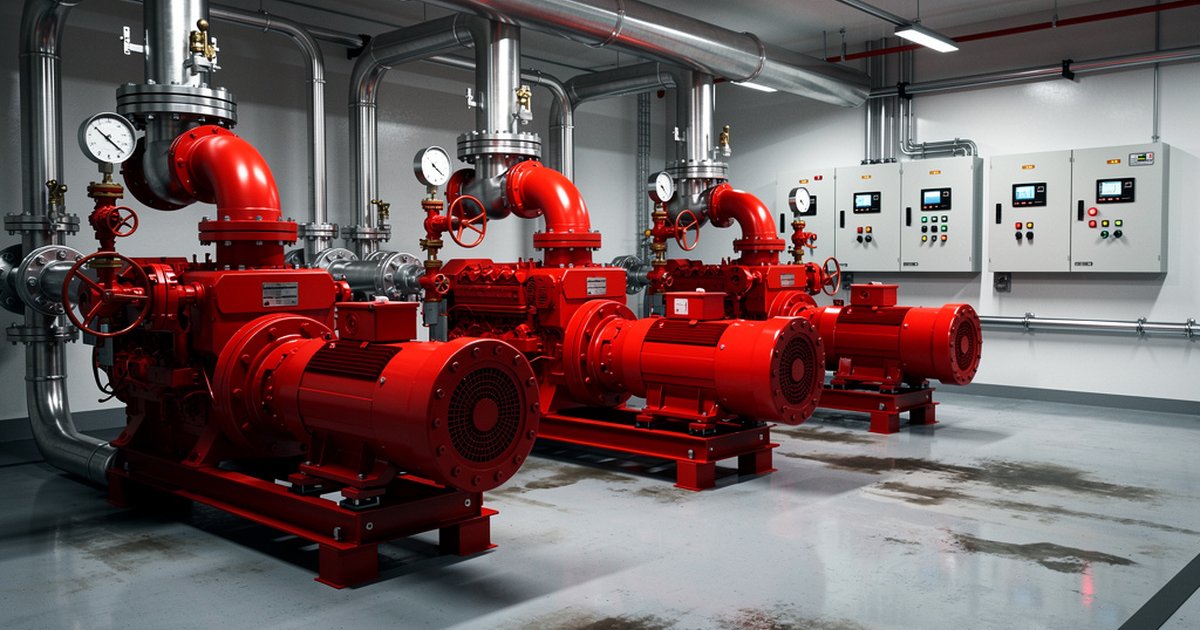
Every fire protection engineer knows the downstream systems — the sprinklers, the foam pourers, the deluge valves. But the component that makes all of them work when a fire actually breaks out is one that rarely gets the engineering attention it deserves: the fire pump. Get the pump selection wrong, and the most carefully designed suppression system in the world becomes a liability. Get it right, and you’ve built the hydraulic backbone of a facility’s entire fire defense.
NFPA 20, Standard for the Installation of Stationary Pumps for Fire Protection, is the governing document for fire pump design in most international and Saudi industrial contexts. It is a detailed, technically demanding standard — and the gap between facilities that comply with its letter and those that understand its intent is wider than most operators realize.
Why Fire Pump Engineering Deserves Its Own Discipline
In many project environments, fire pump selection is treated as a procurement exercise: specify the required flow and pressure, find a listed pump that matches, and move on. That approach produces systems that pass on paper and underperform in practice.
NFPA 20 requires that the entire pump assembly — not just the pump casing itself — be listed for fire protection service. That includes the driver, the controller, the coupling, and in diesel-driven configurations, the fuel supply, cooling system, and battery starting arrangement. Each element interacts with the others in ways that affect system reliability under fire conditions, which are by definition abnormal operating conditions: potentially elevated ambient temperatures, high-demand flow events, and extended run times.
The starting point for any fire pump specification is the system demand calculation. That number — expressed in gallons per minute (GPM) or liters per minute with a corresponding residual pressure at the pump discharge — must account for every simultaneous demand the system may experience: sprinkler demand, hose stream allowances, foam system flow rates, and cooling water requirements. For large Saudi industrial facilities with multiple hazard zones and parallel suppression strategies, these demands can be substantial, and they must be fully resolved before a pump curve is ever reviewed.
NFPA 20 requires the pump to deliver 150 percent of rated flow at no less than 65 percent of rated pressure — a churn-to-runout performance envelope that the pump must meet without cavitation, bearing failure, or driver overload. Selecting a pump that barely meets rated conditions and fails outside the normal operating point is one of the most common — and most costly — engineering errors in fire pump design.
Electric vs. Diesel: Making the Right Driver Decision
The choice of driver is not a preference — it is an engineering and risk decision with direct consequences for reliability and regulatory compliance.
Electric motor drives are simpler, lower-maintenance, and generally preferred when a reliable, dedicated power supply is available. NFPA 20 permits electric-driven fire pumps but imposes strict requirements on the power supply: it must be reliable, sized to start the pump under locked-rotor conditions, and protected from interruption by facility-wide power events. The circuit feeding the fire pump controller must be independent from all other facility loads and must not pass through any disconnect that could be opened during normal operations.
For Saudi industrial facilities, this means that any facility where the normal power supply is subject to grid instability, load-shedding, or planned outages must account for those risks in the driver selection. A facility that relies exclusively on an electric pump and loses power during a fire scenario has no suppression capability — a situation that NFPA 20 and Saudi Civil Defense requirements are both designed to prevent.
Diesel-driven pumps eliminate the power-supply dependency but introduce their own engineering requirements. NFPA 20 mandates a minimum six-hour fuel supply at peak load, a dual-battery starting system capable of six cold-start attempts, automatic weekly exercise runs, and thermal protection for the engine cooling system. In the extreme ambient temperatures common across the Kingdom — regularly exceeding 45°C in summer months — diesel cooling systems require careful engineering. An undercooled diesel that shuts down on high-temperature protection during a fire event is effectively no pump at all.
Most large industrial facilities operating under NFPA 20 and SAES standards implement a combination arrangement: a primary electric-driven pump and a diesel-driven backup, each sized to handle the full system demand independently. This arrangement provides driver redundancy without compromising on either simplicity or reliability. Some high-consequence facilities add a jockey pump — a small pressure-maintenance pump that cycles on and off to hold system pressure and alerts operators to small leaks before they affect the primary pump’s operating point.
Suction Conditions, Piping Design, and the Net Positive Suction Head Problem
Even a correctly selected and properly driven fire pump will underperform — or fail entirely — if the suction conditions are wrong. Net Positive Suction Head Available (NPSHA) must exceed Net Positive Suction Head Required (NPSHR) by an adequate margin across the full operating range of the pump, including at runout conditions. Failure to verify this relationship is a common source of cavitation damage in installed fire pumps.
NFPA 20 specifies maximum suction lift for vertical turbine and horizontal split-case configurations, and requires that suction piping be sized, supported, and arranged to prevent air entrainment, water hammer, and excessive velocity losses. For facilities drawing from above-grade storage tanks or elevated reservoirs, suction head conditions are typically favorable. For facilities with below-grade tanks or long suction runs, careful hydraulic analysis is mandatory — not optional.
The suction piping arrangement must also include provisions for isolation and maintenance without taking the entire pump out of service. NFPA 20 addresses the use of listed indicating valves on the suction side, and SAES alignment generally reinforces those requirements with additional isolation and bypass provisions suited to the maintenance practices common in Saudi industrial operations.
Controllers, Alarms, and Acceptance Testing
The fire pump controller is as critical as the pump itself. NFPA 20 requires listed controllers that provide automatic start on pressure drop, manual start capability, and alarm outputs for conditions including power failure, phase reversal, pump running, and loss of suction pressure. Controllers must be installed in locations that allow safe access during a fire event — not in the hazard area the pump is protecting.
For electric-driven pumps, the controller must provide across-the-line or reduced-voltage starting as appropriate for the motor size and available fault current. For diesel-driven pumps, the controller manages the starting sequence, engine monitoring, and transfer between battery banks. In both cases, the controller annunciates — but does not automatically shut down — a running fire pump, because NFPA 20 takes the position that a pump running under fire conditions should not be stopped by an automated alarm response unless a human makes that decision.
Acceptance testing under NFPA 20 requires a full flow test at churn, rated flow, and 150 percent of rated flow, with pressure readings recorded at each point. The resulting pump curve must be compared against the manufacturer’s certified curve, and any deviation outside acceptable tolerances requires investigation and resolution before the system is accepted. For Saudi facilities subject to Saudi Civil Defense approval, this test data becomes part of the formal documentation package submitted for occupancy clearance.
Periodic testing — typically annual flow tests and weekly or monthly churn tests depending on driver type — is required under NFPA 25 to maintain compliance and verify that pump performance has not degraded. Impeller wear, packing deterioration, and bearing wear all affect pump output over time, and a pump that passed its acceptance test three years ago may not deliver the same performance today.
The Bottom Line
A fire pump is not a commodity item bolted into a room and forgotten. It is an engineered system with a specific performance envelope, a set of interdependent components, and a reliability requirement that no other piece of mechanical equipment in a facility faces in quite the same way: it must work, at full capacity, the first time it is called upon, after potentially years of infrequent operation.
Engineering that outcome requires the right pump type for the hazard, the right driver for the power environment, a suction arrangement that eliminates cavitation risk, a controller that provides complete monitoring without unsafe automatic shutdowns, and a documented testing program that catches degradation before it becomes failure. Under NFPA 20 and SAES requirements, there is no shortcut to any of those steps.
Facilities that treat fire pump selection as a checkbox exercise will eventually face the consequences — either at commissioning, when the system fails its acceptance test, or during a fire event, when the consequences are measured in something far more serious than rework costs.
Work With Ignis Sentinel Engineering
Need a fire risk assessment, a third-party plan review, or an NFPA/SAES
compliance check for your facility? Our engineers help Saudi and international
industrial operators design safer operations.