


HiltonC
A fire alarm system that performs flawlessly during a routine inspection and fails silently during an actual fire is not a safety system — it’s a paper trail. In industrial facilities, the gap between compliant-on-paper and operationally reliable is where lives and assets are lost. Getting that gap closed requires more than selecting a listed panel and placing detectors on a grid. It requires engineering.
NFPA 72, the National Fire Alarm and Signaling Code, is the foundational design standard for fire alarm systems across most of the world. In Saudi Arabia, it operates alongside Saudi Civil Defense requirements and, for Saudi Aramco facilities, SAES engineering standards that impose additional layers of specificity. Understanding how to engineer a system that satisfies all three — not just the most lenient of the three — is what separates a defensible design from a liability.
The Engineering Basis: More Than Detector Placement
Most facility managers think of fire alarm design as a layout exercise — draw the floor plan, place smoke detectors at code spacing, connect everything to a panel. That view is incomplete and, in industrial environments, dangerous.
A credible industrial fire alarm design starts with a fire risk assessment that informs system architecture. What ignition sources exist? What fuel loads are present? What are the process hazards — flammable liquids, compressed gases, combustible dusts? What are the consequences of a delayed alarm? These questions determine detector technology selection, zone configuration, response thresholds, and integration requirements with suppression systems and emergency shutdown logic.
NFPA 72 establishes performance objectives: detect a fire in time to allow appropriate response, notify occupants effectively, and interface with other building systems reliably. The standard provides prescriptive rules for spacing, power supply, survivability, and testing — but it explicitly recognizes that performance-based alternatives are acceptable when the design basis is documented and peer-reviewed. In high-hazard industrial applications, performance-based arguments are often not just acceptable but necessary.
For Saudi Aramco projects, SAES standards often specify requirements beyond NFPA 72 minimums — including redundancy provisions, specific cable routing and fire resistance ratings, integration with Distributed Control Systems (DCS) and Safety Instrumented Systems (SIS), and defined cause-and-effect matrices linking detection to suppression actuation. A designer who treats NFPA 72 as the ceiling, rather than the floor, will produce a system that fails Saudi Aramco’s third-party review.
Detector Technology Selection: Getting the Physics Right
Selecting the wrong detector technology is one of the most common — and most consequential — engineering errors in industrial fire alarm design. Industrial environments are not office buildings. Ambient conditions, process emissions, temperature extremes, and area classification all constrain what will work reliably.
Ionization and photoelectric smoke detectors are appropriate for clean, climate-controlled environments. In a compressor building with diesel exhaust, a chemical plant with process vapors, or an outdoor equipment area exposed to blowing sand and humidity, these technologies generate nuisance alarms at best and corrosion-induced failure at worst.
Rate-of-rise and fixed-temperature heat detectors are more robust in dusty and contaminated environments, but their response lag compared to smoke detection means they are better suited to spaces where fast smoke detection is impractical rather than where it is simply inconvenient. Linear heat detection — a continuous sensing element run along cable trays, conveyor belts, or pipe racks — is a well-proven technology for covering extended linear hazards where point detectors would require impractical density.
Flame detectors — infrared, ultraviolet, or multi-spectrum — are the standard of care for open process areas in petrochemical facilities, where flammable liquid or gas releases can produce rapid, open-flame fires before smoke accumulation becomes detectable. Their field of view, response time, and false-alarm immunity in industrial environments must all be verified through proper detector placement modeling, not assumed from the manufacturer’s rated coverage radius.
Aspirating smoke detection (ASD) systems, which draw air samples continuously through a pipe network to a central detector, are increasingly specified for critical control rooms, electrical switchgear rooms, and UPS rooms in industrial facilities. Their sensitivity — capable of detecting combustion products at concentrations orders of magnitude below conventional point detectors — enables a staged response: investigate, then alarm, then suppress. In environments where a single suppression discharge causes significant operational disruption, this graduated response capability has real value.
System Architecture: Zones, Addressability, and Integration
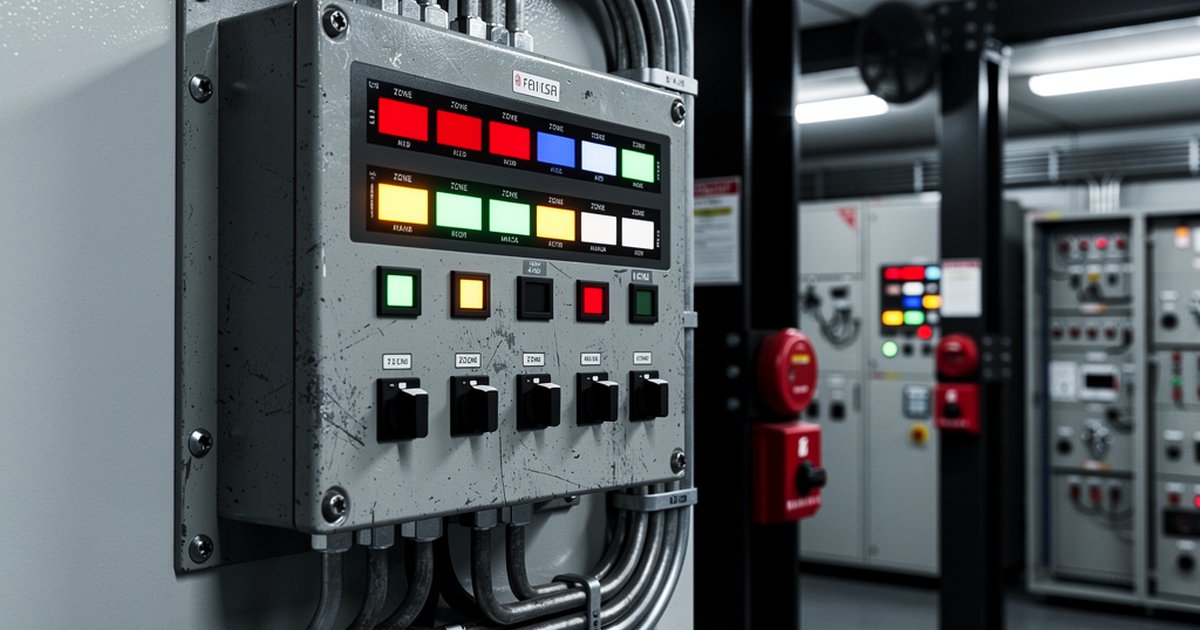
The architectural decision that governs almost everything else is whether the system is conventional (zone-based) or addressable. In industrial facilities of meaningful scale, conventional zoning is almost always the wrong answer. When a conventional panel reports “Zone 4 — Alarm,” maintenance staff may be navigating thousands of square meters to find the initiating device. An addressable system reports the specific device, its location, and its status — cutting response time and reducing the risk that a legitimate alarm is dismissed as a nuisance.
Modern addressable panels in industrial applications are typically networked across multiple field panels tied to a master graphic annunciator, often in the central control room. NFPA 72 requires that this network architecture be survivable — a single point of failure on the communication network cannot render remote panels non-functional or eliminate reporting to the control room. Meeting this requirement in a large facility spread across multiple process units demands careful network topology design, not simply running a loop and hoping for the best.
Integration with suppression systems deserves particular attention. In facilities with pre-action or deluge sprinkler systems, dry chemical suppression, or gaseous suppression in electrical rooms, the fire alarm panel is the initiating logic for suppression release. The cause-and-effect matrix — which detector combinations, in which sequence, trigger which suppression actions — must be engineered explicitly, reviewed by process safety engineers, and tested at commissioning. NFPA 72 and NFPA 2001 both address cross-system integration, and Saudi Civil Defense review will scrutinize this interface closely.
Power Supply, Survivability, and Hazardous Area Compliance
A fire alarm system that loses power in the early stages of a fire emergency has failed its primary mission. NFPA 72 establishes minimum secondary power requirements — typically 24 hours of standby followed by 5 minutes of alarm — but industrial facilities with remote control rooms, large campus footprints, or critical process continuity requirements frequently need to exceed these minimums by design intent, not accident.
Power supply design must account for voltage drop across long field wiring runs — a problem that scales quickly in large industrial facilities. Undersized wiring or poorly distributed power supplies will cause field devices to operate outside their rated voltage range, producing erratic behavior that is difficult to diagnose and often misattributed to defective devices. Battery calculations, wire sizing, and end-of-line voltage verification are not administrative tasks — they are engineering calculations that belong in the design package.
In classified hazardous areas, all field devices must be rated for the appropriate Class, Division, and Group (the North American NEC/NFPA approach) or Zone and Group (the IEC-aligned approach used in Saudi Arabia under IEC 60079 and referenced by SAES). Ignition-capable equipment installed in a Zone 1 area without appropriate Ex certification is not just a compliance failure — it is a potential ignition source in the environment most likely to have a flammable atmosphere present. Hazardous area classification drawings must be cross-referenced against the fire alarm device schedule before procurement, not after.
Commissioning, Testing, and the ITM Obligation
System installation is not system completion. NFPA 72 requires a formal acceptance test — every initiating device, notification appliance, and control function tested and documented before occupancy. In Saudi Arabia, Saudi Civil Defense typically requires witnessing this acceptance test as part of the building occupancy permit process. Gaps in acceptance test documentation are one of the most common reasons industrial facilities face delayed occupancy or re-inspection requirements.
Beyond acceptance, NFPA 72 prescribes a detailed inspection, testing, and maintenance (ITM) program with frequency requirements ranging from weekly visual checks of panel status indicators to annual functional tests of all initiating devices. Industrial environments — with their vibration, temperature cycling, corrosive atmospheres, and process dust — degrade detectors faster than commercial buildings. Facilities that perform only annual tests often discover at test time that detector sensitivity has drifted outside acceptable range, meaning the system would have performed unreliably in an actual event. A quarterly or semi-annual sensitivity verification program, beyond the NFPA 72 minimum, is defensible engineering in most industrial settings.
The Bottom Line
A fire alarm system earns its value in the seconds between ignition and occupant notification — and in the milliseconds between detection and suppression actuation. Every engineering decision made at the design stage either tightens or widens the window in which a manageable event becomes an unmanageable one.
In industrial facilities serving Saudi and international operators, that means engineering to NFPA 72 as a floor, layering Saudi Civil Defense requirements and SAES standards where applicable, selecting detector technologies matched to the actual process environment, and building a commissioning and ITM program that keeps the system in the condition it was designed to operate. Compliance is the minimum. Performance is the standard.
Work With Ignis Sentinel Engineering
Need a fire risk assessment, a third-party plan review, or an NFPA/SAES
compliance check for your facility? Our engineers help Saudi and international
industrial operators design safer operations.